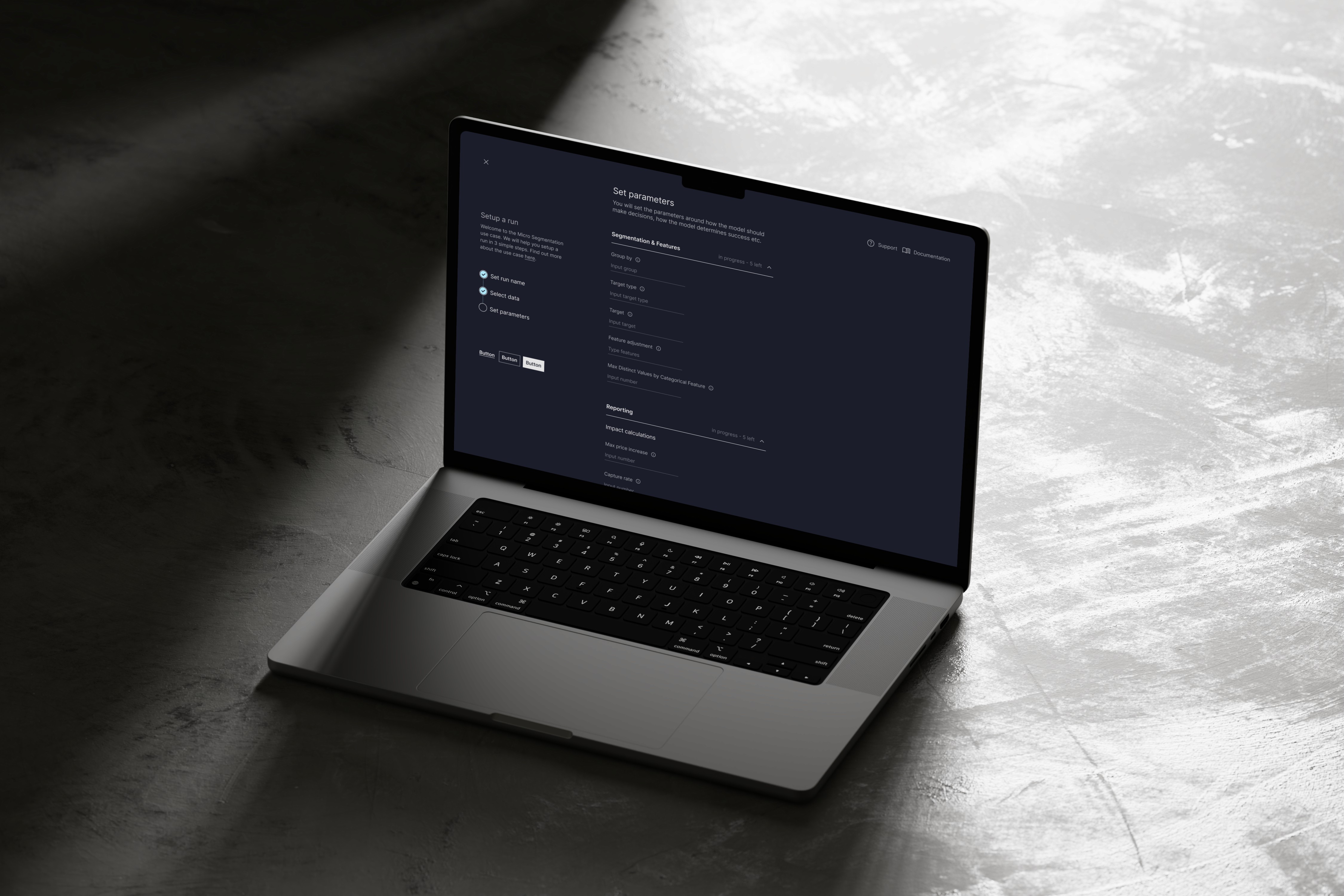
How might we make machine learning usable without code?

How might we make machine learning usable without code?

Services

Services

Product design · User-centred design · Research · Roadmap & success metrics definition · Cross-functional collaboration (engineering & data science)

Product design · User-centred design · Research · Roadmap & success metrics definition · Cross-functional collaboration (engineering & data science)

Description

Description

A platform that simplifies how ML models are created, run and monitored, helping technical and non-technical teams work with machine learning without deep ML expertise.

Built a platform that simplifies how ML models are created, run, and monitored. The goal was to help both technical and non-technical teams work with machine learning systems without requiring deep ML expertise. Growth outcome: onboarding cut from weeks to days and 4 new clients deployed.

Impact

Impact

  • Weeks → days reduced onboarding time

  • 4 new clients deployed

  • Made complex ML workflows usable by non-technical business users

  • Defined product direction and roadmap alongside the tech lead

  • Weeks → days reduced onboarding time

  • 4 new clients deployed

  • Made complex ML workflows usable by non-technical business users

  • Defined product direction and roadmap alongside the tech lead

Year

Year

2024

2024

Timeline

Timeline

Growth

Growth

Location

Location

London, UK

London, UK

overbuilt starting point

PROBLEM SPACE

PROBLEM SPACE

The delivery gaps this work had to close

The delivery gaps this work had to close

Managed Analytics was too technical for the business users it needed to serve, and the team building it was missing key support.

01

Technical Barrier & Current State

Some clients lacked the technical expertise or data science teams to build and sustain AI solutions with the existing tools. The first version of MA had a high technical barrier and needed a redesign to become genuinely intuitive.

Some clients lacked the technical expertise or data science teams needed to build, manage, and sustain AI solutions with the existing tools. The initial version of MA had a high technical barrier, needing a redesign to become genuinely intuitive and user-friendly.

02

Team Dynamics

Two months after joining, a leadership gap emerged: no PM in place and limited understanding of the user. The frontend team was also struggling to implement designs, which created the opening to step in on both fronts.

Two months after joining, a leadership gap emerged with no PM in place, alongside limited understanding of the user. The frontend team was also struggling to implement designs, which created the opening to step in on both fronts.

03

Not Built for Purpose

Users found terms like ‘config’ and ‘parameters’ confusing and felt overwhelmed by how much was on screen. Interactions like navigating the data catalog created friction, and many users preferred working with output data over abstract settings.

Users found technical terms like ‘config’ and ‘parameters’ confusing, and felt overwhelmed by the volume of information on screen at once. Certain interactions, like navigating the data catalog, created friction, and many users preferred engaging directly with output data over abstract settings.

CONTRIBUTION

CONTRIBUTION

Where complexity turned into momentum

Where complexity turned into momentum

As design lead, the work covered running research, shaping the roadmap and stepping into engineering and PM gaps to keep things moving.

As design lead, the work included running the research, shaping the roadmap, and stepping into engineering and PM gaps to keep things moving.

01

Experience Design and Reducing Cognitive Load

Simplified terminology and navigation in direct response to research.

Simplified terminology and navigation directly in response to research, cutting the friction users had flagged.

02

Product strategy

Defined product direction, roadmap and success metrics alongside the tech lead, and established regular user interviews and playbacks to make the team research-driven.

Defined product direction, roadmap, and success metrics alongside the tech lead. Established regular user interviews and playbacks, building a research-driven approach across the team.

03

Cross-functional delivery

Worked closely with engineers and data scientists to scope and ship an MVP quickly, with check-ins to bridge gaps with frontend engineering. Managed sprints and daily stand-ups alongside the tech lead in the absence of a PM.

Worked closely with engineers and data scientists to rapidly scope and ship an MVP, organising check-ins to bridge gaps with frontend engineering. Managed sprints and daily stand-ups alongside the Tech Lead in the absence of a PM, keeping delivery on track through the leadership gap.

Psychology and change

Psychology and change management highlights

Psychology and change management highlights

The first version was too technical for business users, so the redesign made machine learning approachable for people without data science teams.

Psychology

Plain language, not jargon

Plain language replaced terms like ‘config’ and ‘parameters’, so business users could follow without an ML background.

Psychology

Less on screen at once

Screens were simplified to show what mattered at each step, easing the overwhelm of too much information.

Psychology

Starting from the outputs

Many users preferred output data over abstract settings, so the flow led with results they already understood.

Change

Lowering the barrier to start

Usable without code meant teams without data scientists could take part, so adoption didn’t depend on specialist skills.

Change

Faster onboarding as a quick win

Cutting onboarding from weeks to days gave new clients an early win and helped four of them get up and running.

Change

Seeing feedback in the product

Regular interviews and playbacks let users see their feedback shape the redesign, building trust in the new version.

© All right reserved, Early Tomorrow LTD 2026

© All right reserved, Early Tomorrow LTD 2026